
The Edge | The Ultimate Casino: The Yen, Carry Trade & The 160 Line
ARROWFX MARKET INTELLIGENCE
September 2026 | Japanese Yen Special Report
Global FX markets are increasingly being shaped by the intersection of monetary policy, sovereign debt, capital flows and leveraged positioning. In this edition of The Edge, ArrowFX examines the Japanese yen, the global carry trade and the significance of USD/JPY approaching the 160 level—and what these dynamics could mean for businesses with international currency exposure.
MARKET OVERVIEW
Treasury Secretary Scott Bessent this week finally came out and said it: “I am the
house now.”
The Treasury Secretary is once again blurring the lines between the Treasury Department, the Fed, and global
markets. New rules are being written in real time, every day.
The question market participants must ask themselves is why the American Treasury Department would want to
save the Japanese Yen — and why the yen needs saving in the first place. This story pops up, carries massive
weight, and then gets quickly extinguished, while the administration is all over it.
The Anatomy of the Yen Trap
At its core, the JPY story is about free money and debts coming due. For the majority of active traders, Japan has
kept interest rates close to zero for their entire working lives.
The Export Engine vs. China. Japan’s economy is heavily export-driven, historically competing against China —
which follows zero rules when it comes to internal trade laws or currency floats. For years, the U.S. never pressed
China on this unfair trade advantage, essentially letting them peg their currency to support exports in return for
buying most of our U.S. debt. That is no longer the case.
The Return of Yield and the Carry Trade. Interest rates are going up, meaning money will eventually come back
home to Japan where it can earn yield. Then there’s the legendary carry trade — borrow in yen at near-zero rates,
invest in U.S. equities at real returns, and pocket the spread. Free money, until it isn’t.
The Carry Trade — Free Money, Until It Isn’t
STEP 1
Borrow JPY
Near-zero rates Bank of Japan
STEP 2
Buy USD
Exchange at spot Pressure on JPY
STEP 3
U.S. Equities
Real yield Pocket the spread
The yen carry trade is built around a relatively simple concept: borrow in a low-interest-rate currency such as the Japanese yen and invest the proceeds in currencies or assets offering higher yields. When U.S. interest rates remain substantially above Japanese rates, that yield differential can make yen-funded positions attractive. As long as the yen remains relatively stable or weak, investors may benefit from both the higher yield and favorable currency conditions.
The risk emerges when that relationship reverses. A stronger yen, falling U.S. yields, rising Japanese rates or a sudden deterioration in global risk sentiment can force investors to reduce leveraged positions quickly. Yen must then be purchased to repay yen-denominated funding, potentially accelerating its appreciation. What begins as a currency adjustment can therefore become a broader deleveraging event affecting equities, bonds and other risk assets around the world.
From the 1980s Bubble to the 2008 Playbook
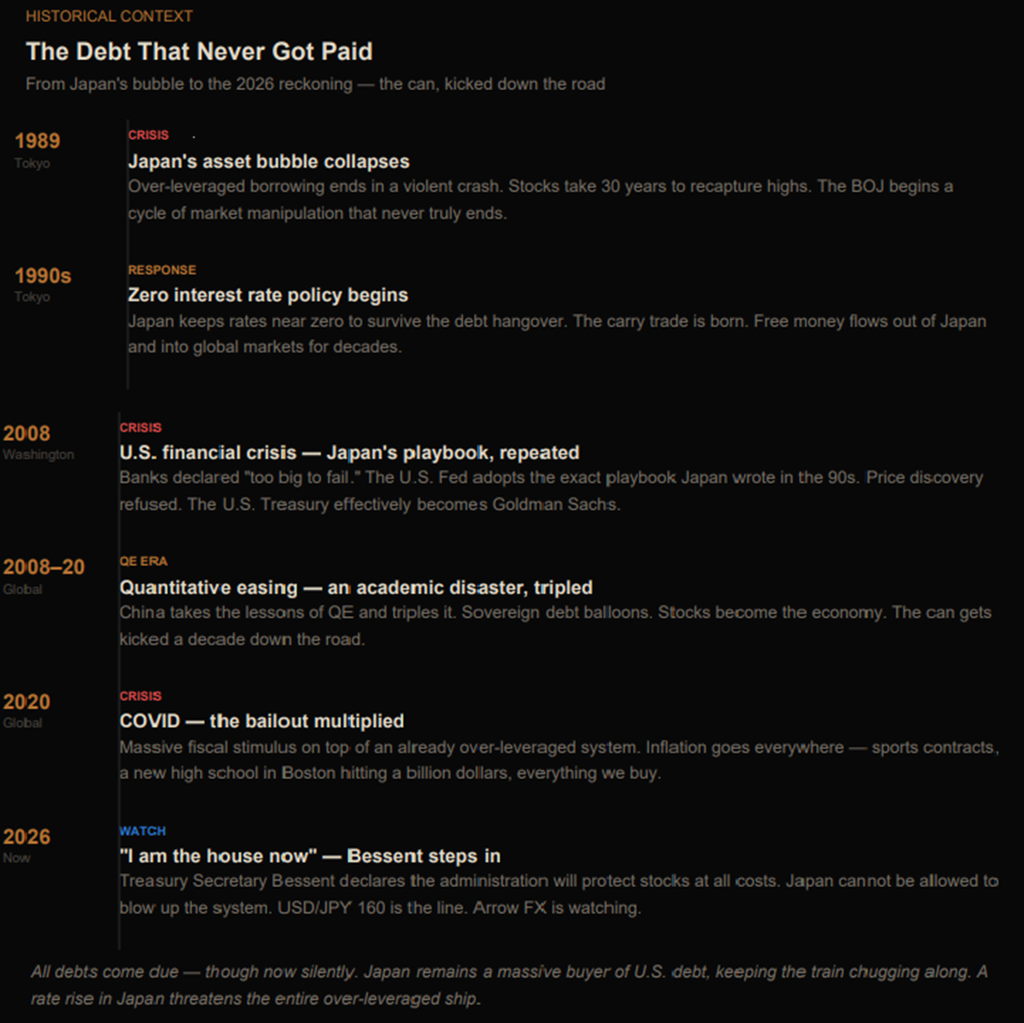
Past the scream sheet of headlines, this has always been a story of debt and market manipulation. Starting in the
80s — when Japan seemed to be buying Disneyland, the Dodgers, and all of New York City — their
over-leveraged borrowing led to a violent crash. That explains negative interest rates far more than the often-cited
export-driven economy. They bet big, got super over-extended, and lost.
And this is why, for many of us, the 2008 bailout still stings. We were told it was too complex for the average voter
to understand. That’s not true; finance’s job in many ways is to complicate the mundane. Ask Warren Buffett.
Japan quadrupled down and lost big, and stocks took thirty years to recapture their 80s highs
The banks became “too big to fail,” and the lenders and traders themselves called
themselves “too big to jail.” Once you start down the path of market manipulation —
forever will it dominate your destiny.
ARROW FX TRADING DESK
The Sovereign Debt and Inflation Cycle
And now we have major inflation. It’s everywhere — sports contracts, the cost of a new high school in Boston hitting a billion dollars so quickly, and everything we buy in our own lives skyrocketing. This is the bailout times COVID times the sovereign debt cycle.
We kicked the can down the road in 2008 and never paid for it; Japan never paid for 1989. What did we learn? All debts come due — though now silently, as Japan remains a massive buyer of our U.S. debt, keeping the U.S. train chugging along.
A raise in interest rates in Japan threatens the entire over-leveraged ship. China took the lessons of QE — by all measures of academia a complete disaster — and tripled it. And since we refused price discovery in 2008, the U.S. Treasury under George W. Bush effectively became Goldman Sachs. Because of Japan’s mountains of debt which cannot be paid back, inflation presents quite a problem.
The 2026 Shift: Protecting Stocks at All Costs
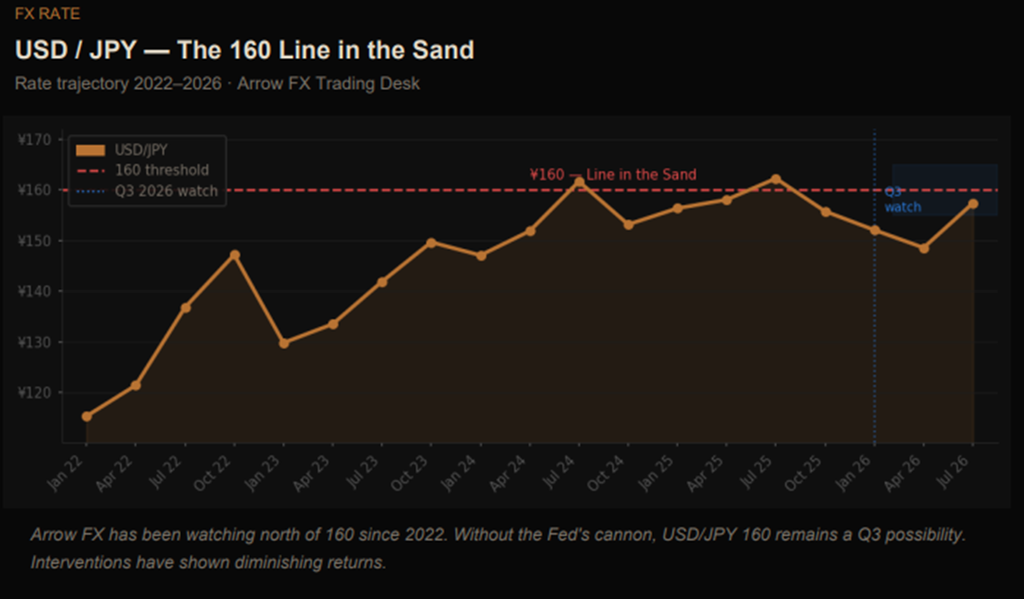
Japan, if not protected, can blow up everything. Japan for years signaled that 160-161 was their line in the sand, so we’ve looked forward for our clients north of 160 since 2022. And now we have a new player: the house himself, U.S. Treasury Secretary Scott Bessent
They have to protect the stock market at all costs. Stocks took center stage post-2008, and now the entire global economy — including the U.S. dollar — trades off what stocks do. In 1999 and every year before that, this was never the case.
Given the amount of JPY shorts out there, it was poised for a squeeze, and we’re seeing that play out. The game of chicken is traders knowing no one can raise rates — certainly not Japan.
A major correction in equities over the last decade caused the dollar to strengthen; however, that hasn’t been the case in 2026. This is a major development as it creates new safe-haven dynamics and shifts the metrics we look at for forecasting FX markets. As equities rise the dollar sell-off has been muted and vice versa. New metrics are emerging.
Desk Positioning & Recommendation
We’d give pause locking in forwards here at these lows. The Japan intervention — unparalleled by the U.S.
Treasury — tells the much bigger story. The administration, already confusing stealth QE (quietly expanding
the balance sheet without calling it QE), will protect stocks at all costs. This will limit USD/EURO upside for
now.
The JPY is a different story. Interventions have had diminishing returns. The cannon got larger. We’ll monitor
through the end of September. Without the Fed’s cannon, USD/JPY 160 is a Q3 possibility. The strength
of his words will be greatly tested. We’ll be watching.